The Best Way to Repair Credit: A Prioritized Strategy That Works
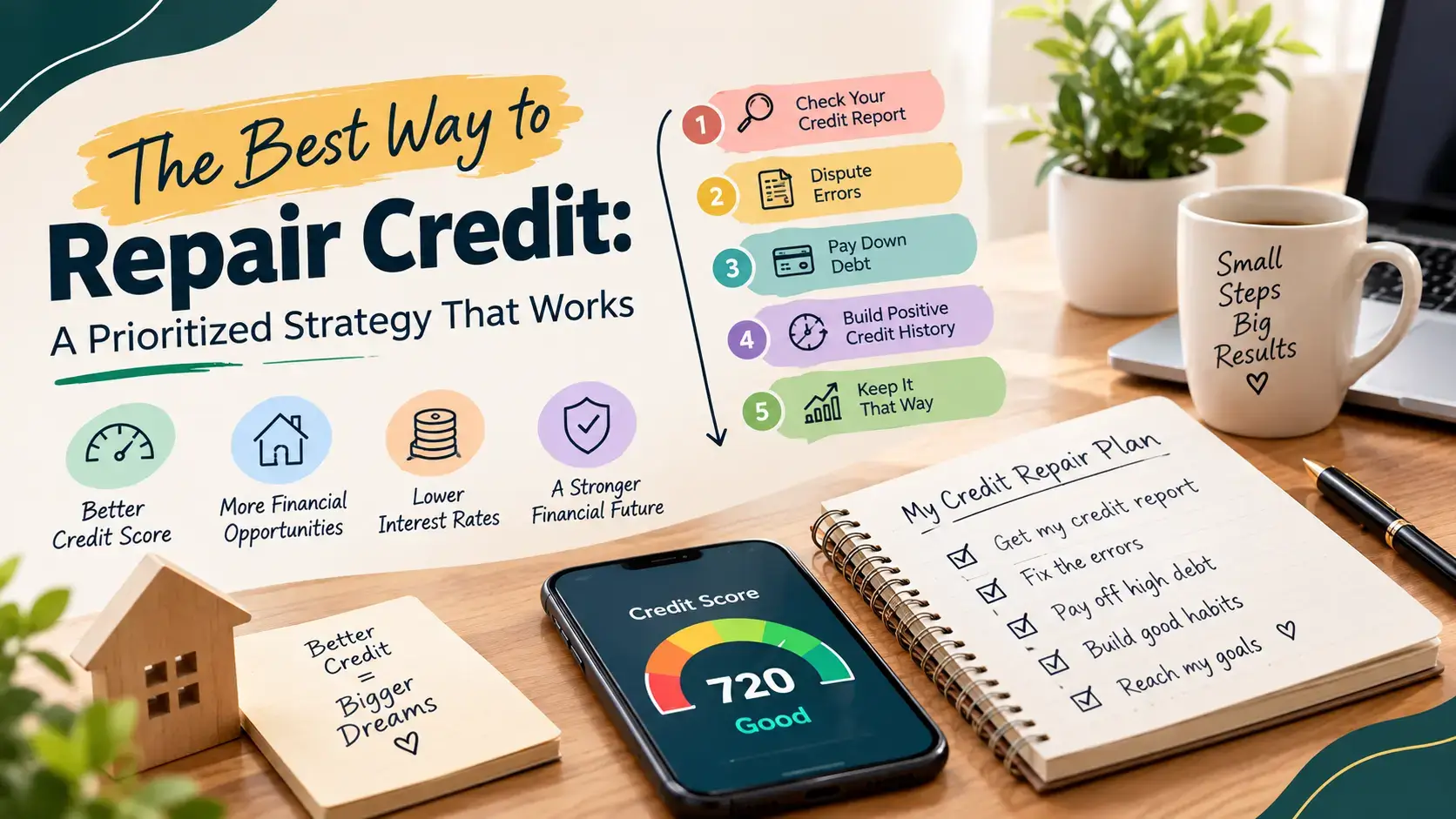
There isn't just one trick that will help you fix your credit. It goes in this order: fix what's wrong, stop new damage, and make history good, because that's what makes things better. People who think of repair as a single step (like writing a dispute letter or paying off a card) tend to put it off. Most of the time, people who run the pieces together don't.
These steps work most of the time, and they will help you decide how much of the work you should do yourself.
Rule 1: Fix mistakes first, since they're the easiest to fix.
There's nothing better than getting rid of something bad that shouldn't be there. A lot of studies and reports on consumer protection have found that credit reports have at least one mistake on them. This step pays off more often than people think.
-
AnnualCreditReport.com lets you get free reports from all three credit bureaus.
-
Check for accounts that aren't yours, wrong balances, duplicate collections, wrong late payments, and things that have been reported too many times.
-
Each one should be disputed with the bureau in writing and with proof. Bureaus usually have 30 days to look into something, and anything that can't be proven must be taken down.
It's the first step because it doesn't cost anything and gives you the most return.
Principle 2: Stop the damage before you build again.
It's not worth the time or effort to rebuild when new damage keeps coming in. Before anything else:
-
Pay off bills that are past due.
-
Put the bare minimum on every account so that it pays itself every month.
-
Don't try to get more credit unless you really need it.
-
If you have a good reason to close an old account, don't do it. It can hurt your average account age and usage.
Most scoring models base your score on your payment history, so if you miss a payment, it can undo months of progress.
Third principle: Less use, the fastest score lever
The amount of your revolving limit that you're using changes every month, and this is one of the fastest ways to move a score.
-
Aim for less than 30% on each card and as a whole; less than 10% is better.
-
Pay off any balances before the end of the statement period, as that is generally the last number shown.
-
Give more weight to the card that has the highest utilisation percentage rather than the one that has the biggest balance.
Principle 4: Deal with real problems in a planned way
Negative facts can't be argued away, but you still have choices:
-
Goodwill letters are sent to lenders who have been good except for a few late payments.
-
You can pay to get rid of collection accounts, but you need to agree to this in writing before you pay.
-
Before you pay off very old debt, make sure you know the time limit for filing a debt and the statute of limitations. Some payments can make things more difficult.
-
Time should do its thing. It takes seven years for most negative items to stop being scored after they have been around for seven years.
Principle 5: Write a new, good history
Getting rid of bad things only helps you so much. When there is good news, a score goes from "recovering" to "good."
-
If you use this card or loan sparingly and on time, it will help you build your credit.
-
Authorized-user position on a well-kept account, if a reliable person offers it.
-
On-time payments every time for everything else.
Effects that can be seen generally start to build up after 3 to 6 months.
How to Choose: Do It Yourself, Pay for a Service, or a Mix?
|
Your situation |
Likely best approach |
|
One or two clear errors, plenty of time |
DIY disputes |
|
Several negative items across multiple bureaus |
DIY with a tracking system, or a credit repair company |
|
Limited time, many moving parts |
Credit repair company |
|
Credit work tied to a bigger goal (mortgage, business funding) |
A provider that offers broader financial strategy |
|
Very old debts, legal questions, suspected violations |
Consumer attorney or nonprofit credit counselor |
If you want to fix your credit properly, you can do everything the company does for free. What you're paying for is their time, tracking, and follow-through.
A strategy-led provider may be better for people whose credit work is linked to bigger goals than a dispute-only service. Heads Up Financials, which fixes your credit report across all three bureaus and pairs you with a mentor for six months. At higher levels, it also helps you build your business's credit and get loans. It works better if you need a dedicated strategist and a plan than if you only need one or two things cleared up. Before you pay any provider, make sure you get a written agreement that includes pricing, billing dates, and contract terms. Also, keep in mind that no company is legally allowed to promise a certain score rise.
How to tell if a "best way" pitch is bad
-
Under the Credit Repair Organisations Act, it is illegal to charge money up front before work is done.
-
Guaranteed deletions or score boosts: no real service can make these promises.
-
People are told to dispute everything or make a "new credit identity." The second option (CPNs) is fraud.
-
There is neither a written contract nor the right to cancel. CROA needs both.
A simple plan for 90 days
Days 1 through 7: Get all three reports, make a list of mistakes, and file formal complaints. Turn on autopay for all of your bills.
Days 8–30: Pay off the cards that you use the most. For single late payments, send letters of goodwill. Need to? Get a secured credit card or a loan to help build your credit.
Days 30–60: Look over the disagreement results and send unresolved issues to a higher level with more proof. Talk about collections in writing.
Days 60–90: Pull reports again to make sure the changes are correct and keep usage low. Figure out if the problems you still have require outside help.
Questions people often ask.
Is there a way that works for everyone?
No. What's on your reports will tell you the best way to proceed. The above rules (fix mistakes, stop new damage, lower usage, deal with accurate negatives, and build a positive history) are generally true, but each step has a different importance.
Should you pay to fix your credit?
When there are a lot of things to do, it can be worth it if you value time and following through. Sometimes, do-it-yourself is enough if you only have one or two mistakes.
How long does the best way to do things take?
Most of the time, it takes 3 to 6 months to see visible improvement and 6 to 12 months for a deeper recovery. In severe cases, it can take longer.
Fixing my credit score will definitely get me a loan, right?
Not at all. Lenders also look at things like income, the debt-to-income ratio, and other factors.