How Do Credit Repair Companies Remove Items?
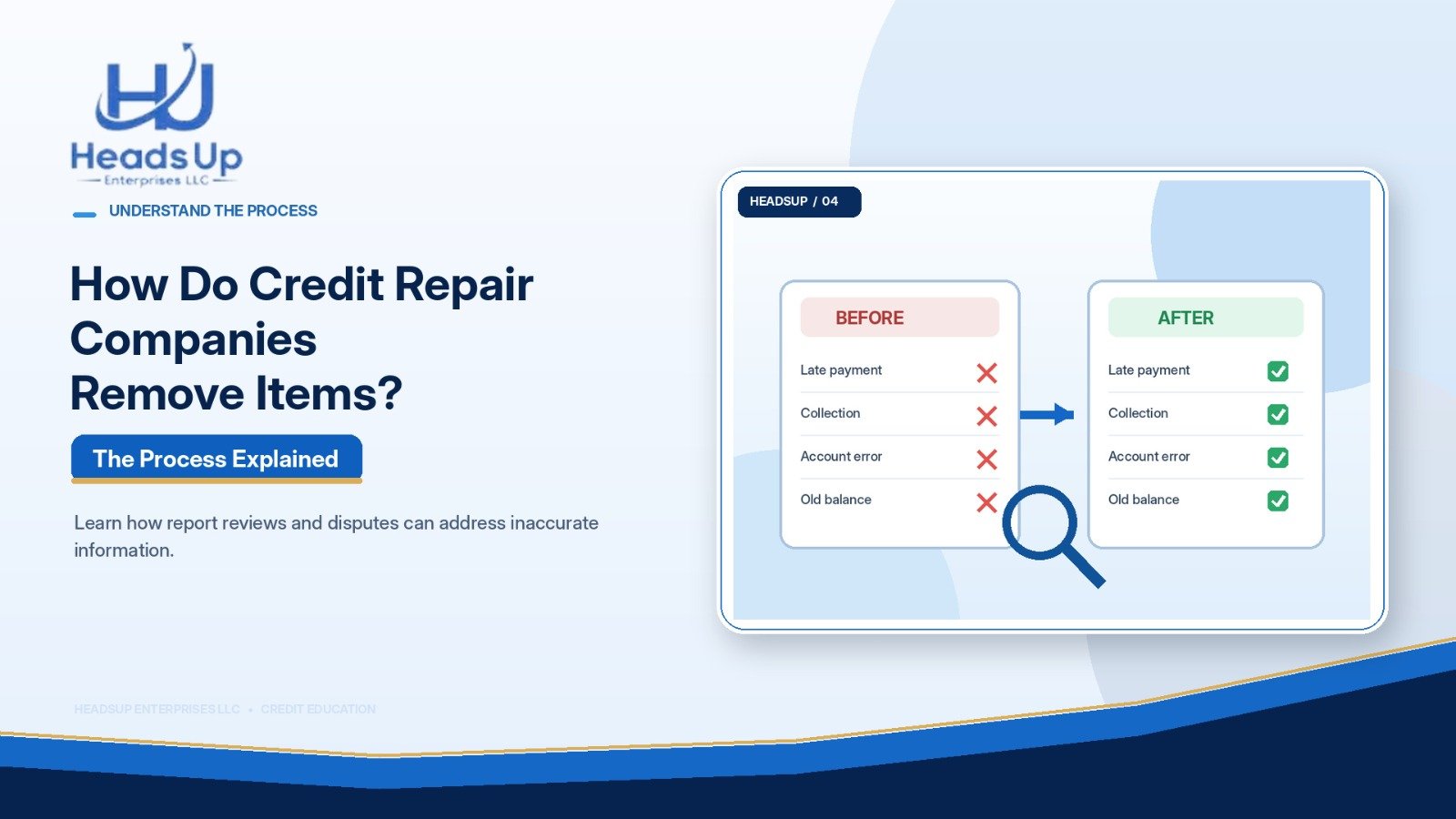
The method of credit repair is well documented. Most of these are under the umbrella of consumer protection laws. Because of this, anyone can do credit repair. You can save money and use the information below to evaluate any credit repair company.
You have a right to your credit report.
Most legitimate removals stem from the Fair Credit Reporting Act (FCRA). The FCRA states that credit bureaus and furnishers must maintain complete and accurate information. Three other key laws are the Fair Debt Collection Practices Act (FDCPA) and the Credit Repair Organizations Act (CROA).
A credit repair company cannot gain access to the credit bureaus directly. They exercise these rights for the masses and follow up.
Method 1: Disputing inaccurate or unverifiable items with the bureaus
Look over your credit reports.
-
Audit your reports. The credit repair company will pull your reports and flag anything wrong, incomplete, duplicated or outdated.
-
File disputes. The credit repair company will complete a dispute letter outlining what is incorrect and why.
-
The bureau investigates. The credit bureau has 30 to 45 days to review the furnisher and the dispute.
-
The outcome: Dispute a reasonable number of errors to start and see how aggressively the bureaus will investigate.
The information must be corrected or deleted if the furnisher is unable to verify the information or verifies it is inaccurate. If the furnisher affirms the information is accurate, no changes are made.
Typical reasons include: Accounts with balances or dates that do not pertain to you, duplicate accounts, incorrectly reported late payments, and accounts that should not be listed.
An exception: The bureaus predominantly rely on an automated system to verify the disputed information with the furnisher. This is why more complicated, well-documented disputes tend to succeed more than form letters.
Method 2: Disputing directly with the furnisher
Creditors are required to investigate all disputes and, if the information is inaccurate, correct it. Credit repair organizations do both. This means that, in addition to disputing the information with the credit bureaus, they contact the creditor directly. This is extremely useful if the creditor made a reporting error that can only be fixed with the creditor, like a reported payment that was made on time, but was reported as being late.
Method 3: Debt validation requests
The FDCPA allows the consumer 30 days from the first notice by the collector to request validation of the debt. Debt collectors must cease collection until they respond to the validation request.
This works when:
-
The collector does not prove ownership of the debt or the right to collect on it
-
There are discrepancies in amounts, dates, or both, from the original records
-
The debt is not owed by the consumer
-
There is failure to respond to disputes appropriately
This works more often than people expect, because many debts are bought and sold multiple times and records of those transactions are often not maintained.
Method 4: Challenging Reporting Time Limits and Re-Aging
Debt can be reported negatively for seven years from the date of first delinquency, and for ten years from the date of Chapter 7 bankruptcy. Credit repair companies find out if:
-
An item has exceeded that time frame.
-
A collector uses a date to re-age an old debt (re-aging is a violation of the FCRA)
Both are legit removal reasons, and are frequent findings during an audit.
Method 5: Goodwill Adjustment
An item is removed because it is a courtesy. Goodwill adjustment requests usually work for the first and only late payment on an otherwise clean account. It is mostly effective with credit unions and smaller financial institutions. No credit repair company can ensure a goodwill adjustment will work.
Method 6: Settlement Negotiation
For collection accounts, some credit repair companies may try to negotiate an agreement to pay, and in turn have the account deleted. The legitimate version is:
-
It is documented in writing, prior to any money being exchanged.
-
It is more common with 3rd party collection agencies versus creditors.
-
It is not always possible. Some agencies will not negotiate deletion.
Some credit repair companies handle this negotiation for you, while others only handle bureau disputes. Ask which applies.
Method 7: Removal of Fraud/Identity Theft
Along with disputes, the FCRA allows you to request the block of accounts resulting from identity theft. Obtaining a police report or an FTC ID Theft report can assist in this process. This process is more formal and may be faster than a dispute.
Method 8: Escalation
https://www.zerogpt.com/ai-humatheft,
-
Filing disputes with new documentation
-
Asking for the means of verification the bureau used to authenticate the item.
-
Sending a complaint to the CFPB, which often results in the furnisher responding more closely.
-
Sending a case to an attorney in the case of a clear FCRA or FDCPA violation.
Service providers that utilize law firms may be more capable of doing this last step, because of statutory damages.
What Credit Repair Companies Cannot Do?
This part is important because this is where most consumers are disappointed and scammed.
-
Credit Repair Companies cannot make negative, verifiable, accurate information disappear just because a consumer pays them.
-
Credit Repair Companies cannot guarantee specific deletions, nor can they guarantee specific score improvements. CROA prevents these types of practices.
-
Credit Repair Organizations Act (CROA) states that credit repair companies cannot bill their clients until their services are rendered.
-
CPNs are “Credit Privacy Numbers”, made by companies called “Credit Privacy Protection Services”. They are fake Social Security numbers used to create an alternative credit identity. They are fraud and illegal. Credit Repair Companies cannot advise you to get a Credit Privacy Number.
-
Credit Repair Companies cannot force the credit bureaus to respond to their requests faster than the legal timelines.
Accurate negative items can disappear in 3 ways: 1) They can age away. 2) They can be negotiated away through an agreement. 3) They can be removed through goodwill. Disputing does not make them disappear if they are accurate and can be verified.
Operators make many identical disputes to furnishers, hoping that they will not respond in time, and the negative item will be removed. This is called dispute flooding. There are potential issues with dispute flooding.
-
Bureaus can treat repeated or silly disputes as such and will refuse to investigate.
-
If an item is deleted, it does not mean it will not reappear. A furnisher can verify it in the future, and the bureau is required to notify you when it happens.
-
If a negative item on your report is accurate, and you dispute it by saying it’s inaccurate, you’re putting yourself at risk because you’re approving what’s being disputed.
A good Credit Repair Company can explain, item by item, the reason for filing the dispute.
What the process looks like with a company
|
Stage |
What typically happens |
Timeline |
|
Onboarding |
Reports pulled, contract signed, items identified |
Days to 2 weeks |
|
Round 1 disputes |
Disputes filed with bureaus and, where relevant, furnishers |
~30-45 days to respond |
|
Follow-up |
Verified items re-disputed with more detail, validation requests, goodwill, and negotiation |
Months 2-4 |
|
Ongoing |
Monitoring, new errors, reappearances |
Months 4-6+ |
Most programs run several months because each round takes about a month to resolve and not every item resolves in the first round.
How long does it take?
-
Typically, you will be required to sign a contract and allow the Credit Repair Company to pull your credit reports. During the onboarding process, the Credit Repair Company should identify the negative items that they will be disputing on your behalf. This process can take between a few days and 2 weeks.
-
After the negative items have been identified, they are disputed. After the dispute is filed, it can take the credit bureaus 30 to 45 days to respond. During this time, there is not much you can do but wait.
-
Once the credit bureaus respond to the dispute and the item is verified, further action can be taken to request the removal of the item through goodwill and negotiation with the furnisher.
-
This process can take between 2 and 4 months.
Where Heads Up Enterprises fits
Heads Up Enterprises credit repair mentorship provides the removal of inaccurate negative items across all three credit bureaus in a six-month one-on-one program, as well as help with establishing business credit and credit funding in higher tiers. I could not confirm their detailed dispute methodology, so I would ask the same questions of the company and any other credit repair service.
-
What methods do you use and what types of items do you dispute?
-
When do you file the first round of disputes, and what is your pace?
-
Do you and/or will you communicate with collectors, or do you limit yourself to disputes with credit bureaus?
-
What is your process and/or what do you do when an item is verified by the credit bureau?
-
When do you bill me? What does your contract say about cancelling?
How to Confirm a Credit Repair Company is Working
-
Contracts should provide a customer the ability to cancel at any time and in writing. Customers should receive a confirmation that their cancellation request is processed.
-
Customers should receive a copy of disputes filed or have access to a dashboard reflecting disputes filed and when.
-
Disputes should refer to specific accounts, not generic ones. Customers should be able to see bureau responses.
-
CROA dictates that a credit repair company should not bill the consumer until the service is performed.
Asked questions
Can a credit repair company really delete accurate items?
No, a credit repair company cannot delete accurate items. If the item is accurate and verifiable, the paths to removal are time and goodwill/negotiation. Disputes are used to remove errors and unverifiable items.
Why do items sometimes come back after being removed?
A furnisher can later verify an item that was deleted because of a missed deadline or incomplete response. The bureau must notify you of this.
Is a 609 letter a loophole?
Yes. Every method described above is available to consumers directly. A company primarily adds time, organization and persistence.
Can I handle all of this on my own?
Yes. Every method described above is available to consumers directly. A company primarily adds time, organization and persistence.
How can a company remove items from your file?
The number of items a company can remove depends on the issues in your file. A consumer with several issues may see many removals while a consumer with fewer may see fewer.
Do deletions always improve my score?
It depends on the item that was deleted. It also depends on how old the item is and what else is on your report. Deletions typically improve your score.