Credit Report Repair Tips: 25 Practical Ways to Clean Up Your Report
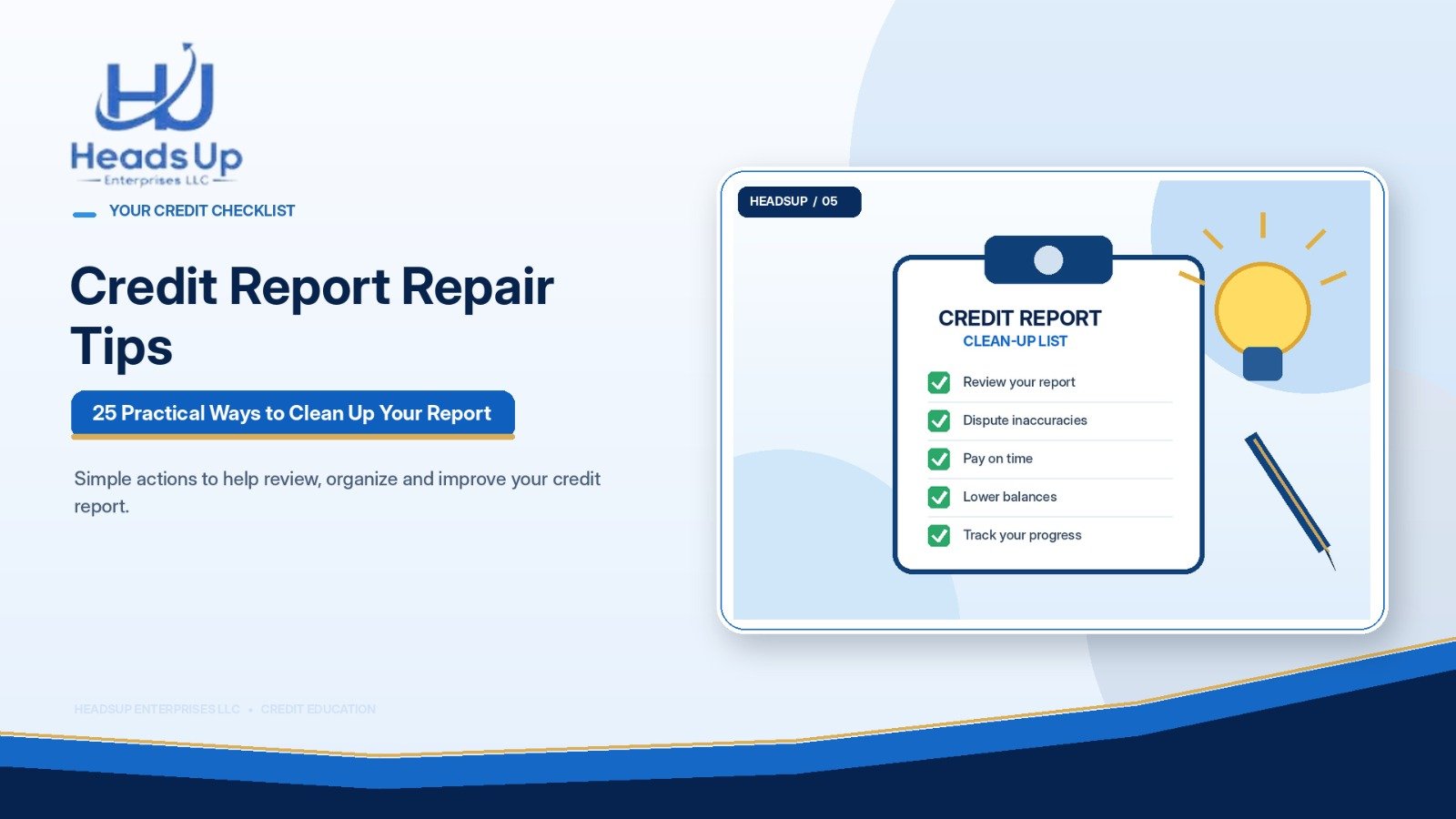
Repairing a credit report requires some know-how and a few tasks done consistently. These tips are divided into different sections and you can either start at the top and work your way down or jump to the section dealing with your problem.
Part 1: Get organized before you touch anything
1. Pull all three reports, not one.
The three credit reporting agencies do not all have the same information. One of the reports may show an account that is not shown on the other two. You are permitted to pull your credit reports once a year from each of the credit reporting agencies. You can obtain them for free by going to the AnnualCreditReport.com website.
2. Read the credit reports, not the score.
A credit report score tells you how you are doing, and the credit report itself tells you why. Read each account, inquiry and personal information to see if there are any errors.
3. Make a tracking sheet.
Make a tracking sheet to organize the information. Track the account name, the error, the bureau, the evidence, the date you disputed the item, and the outcome. With disputes, there is a 30-day time limit, so without a tracking sheet, it is easy to lose track.
4. Save everything.
You need to keep proof for disputes, and there are several ways to keep a record, including making copies of your statements, payment confirmations, letters, and/or taking screenshots.
5. Check the stuff too.
You should also check your information for things like misspelled names, wrong addresses, and employers you never worked for. This could mean there is a problem with your files.
Part 2: Find what’s actually wrong
6. Look for accounts you do not recognize.
It could be a reporting mistake or somebody with a similar name. It could also be fraud. If it's fraud, go to the identity theft section, tip 13.
7. Check payment history against your records.
You may have an account that shows up on your credit report as 30 days late, even though your bank shows it as on time. This is something you would want to dispute.
8. Look for duplicates.
Debts can be collected and reported more than once, often inflating the total amount owed and negatively affecting your credit score.
9. Verify the dates.
According to law, a negative item can only be reported for 7 years from the date of the first delinquency. If a debt collector attempts to keep a debt fresh by reporting it as recently charged off, this is considered a violation and should be disputed.
10. Check balances and credit limits.
An incorrect credit limit can falsely inflate your account utilization. Discrepancies between your records and what is being reported should be disputed.
11. Check closed accounts and bankruptcy notations.
A closed account should show as closed by the consumer, and a bankruptcy account should show a zero balance.
12. Count your hard inquiries.
You can dispute hard inquiries that you did not give authorization for. Other inquiries fall off after two years.
Part 3: File disputes that actually work
13. Take the right route for fraud.
If fraud has occurred, you should file a report at IdentityTheft.gov and request a fraud alert and block on the fraudulent accounts. This process is stronger than a regular dispute.
14. Be specific.
“This isn’t mine” is not a strong dispute statement. A stronger option would be to say, “This account was opened in 2022 at an address I never lived at. I have included a copy of my ID and Utility bills from that time.”
15. Dispute with the bureau and the furnisher.
The furnisher is the creditor. A dispute with them may help resolve the issue only if they are able to.
16. Dispute in writing and keep a copy.
Forms may be convenient, but when you need to provide supporting documentation, certified mail may be better.
17. Don’t dispute if you know it is accurate.
Disputing something you know is accurate may be flagged as a frivolous dispute, and it may slow down the process of your other disputes.
18. Follow up at day 30.
Call the Bureau to check the status of your disputes. If an item is returned as ‘verified’ and you believe it is inaccurate, contact the bureau to provide additional documentation.
19. Use the CFPB when you hit a wall.
A complaint with the CFPB may encourage the furnisher and/or Credit Bureau to look further into the issue.
Part 4: Handle the negatives that are accurate
20. Consider a Goodwill letter for a one-time mistake.
A Goodwill letter may help resolve a blemish on your report from a late payment if you are otherwise a good customer. It may be helpful when dealing with a credit union or small bank.
21. Validate collection before paying.
Send a debt collection agency a letter and ask for validation of the debt within 30 days of their first contact with you.
22. Get pay-for-delete in writing first, if you try it.
Don’t pay money for a promise on the phone. Be aware that some collectors will refuse flat.
23. Know your state’s statute of limitations before paying off old debt.
In some states, making a small payment can reset the clock on collecting the debt. This is in addition to the credit reporting timeline.
Part 5: Strengthen what’s left
24. Lower your utilization.
The goal is to get your utilization to under 30% and, even better, under 10%. Paying your balance before your statement closes can help, as your card issuer will report your balance to the credit bureaus and show your credit report and score with your low balance. This is one of the few actions that can improve your credit score in a month or two.
25. Add positive history.
Open a secured credit card or credit-builder loan and use it sparingly and pay it on time to improve your credit score over time and boost your credit history. Don’t close old credit accounts and don’t apply for a bunch of new credit accounts at the same time.
Part 6: Know When to Get Help
All of the steps above can be done on your own for free. Help may be needed if there are negative items on the report, you are in a time crunch, or you are trying to meet a goal with a deadline (such as buying a home). Heads Up Enterprises is one of the available options if you need more than dispute letters. It does credit repair across all 3 bureaus. It also includes a mentorship program, and higher tiers include business credit and funding. Like all credit repair services, determine if you want just the disputes done or a strategist for the overall process. Get any agreements done in writing. No one can legally guarantee a specific score or deletion.
Things to watch for with a service
They charge you upfront and do no work. They promise a specific score increase or a deletion. They recommend a "credit identity" or CPN. They do not give you a written contract and/or a right to cancel. They tell you to dispute everything, even if it's accurate.
A one-page quick-start
|
Week |
Do this. |
|
1 |
Pull all three reports, build your tracking sheet, and set autolowy everywhere. |
|
2 |
File documented disputes and request validation on any collections. |
|
3-4 |
Send goodwill letters, and pay down the highest-utilization cards. |
|
5-8 |
Review results, and escalate “verified” items you can still challenge |
|
3 months |
Re-pull reports, confirm deletions held, keep balances low |
|
6 months+ |
Maintain, monitor, and add positive history.challenge. |
Frequently asked questions
What's the important tip?
You should look for the errors first. Those are the quickest to remove.
How frequently should I review my credit reports?
You can request your credit reports for free once a year at AnnualCreditReport.com. You should review your credit reports frequently during repair and again after dispute results.
Does disputing my credit report lower my credit score?
No, checking your credit report will not affect your credit score. Disputing items on your report is considered a soft pull and will not affect your credit score.
Once an item is deleted, can it be added back?
It is rare, but the bureau is required to notify you if that happens. That is why follow-up checks are recommended.
How long until I see results?
It takes about 30-45 days to see results of a dispute, and in the meantime, habits to help rebuild your credit are visibly helping you gain and maintain your score. It is not uncommon to see results in 3-6 months.